Why the Star-Spangled Banner is so awesome
The Star-Spangled Banner is a unique national anthem because it doesn't talk primarily of the country it represents, or of its government, people, or power. Rather, the Star-Spangled Banner talks almost exclusively about the young nation's flag.
The lyrics were written under exquisite circumstances: The Americans were fighting the British a second time after the American Revolution in the war called the "War of 1812". The British had captured a number of Americans and were holding them as prisoners. The U.S. dispatched Francis Scott Key and John Stuart Skinner on a boat flying a flag of truce. They then boarded a British ship to attempt to negotiate the exchange of prisoners.
The negotiations were eventually successful, and the prisoners were eventually exchanged; however, the U.S. negotiators were told about the British's plan to attack the U.S. at Fort McHenry in Baltimore, Maryland. Consequently, Francis Scott Key and John Stuart Skinner were not allowed to return until the battle was over so they couldn't warn the U.S. of the British plan.
Furthermore, they were forced to helplessly watch as the British continued to carry out their battle plan, bombarding the tiny U.S. fort with bombshell after bombshell without warning. Fort McHenry was endlessly bombarded throughout the entire day, and Key and Skinner kept their eyes glued on the flag at the top of the fort, which was their only indicator that the fort was still under the control of Americans. The flag was in the process of being torn and damaged as the sound of rockets and destruction hammered through the air. Yet it remained, proudly visible, until twilight's last gleaming.
Once night fell, Key and Skinner could no longer see the flag. One can only imagine the anxiety they must have felt. In spite of the darkness, the British continued to bomb Fort McHenry through the night. Key and Skinner, no longer able to see the flag of their country, could only hear the loud bursting of the bombs as they battered the poor fort. Perhaps guilt swept over them: they knew about the British attack beforehand, but they weren't able to warn the United States in time. This attack could lead to the fall of their young nation! Oh what a nightmare!
As daylight broke through the horizon, it revealed a sight which would flood Francis Scott Key with an overwhelming feeling of joy and ecstasy. It was this awe-inspiring sight that showed that despite how bleak the odds were stacked against them, the Americans had stood their ground, and remained in control of their fort.
It was the sight of their flag, as it waved jubilantly over the fort, basking itself in dawn's early light.
.svg) |
| The current flag of the United States. |
The negotiations were eventually successful, and the prisoners were eventually exchanged; however, the U.S. negotiators were told about the British's plan to attack the U.S. at Fort McHenry in Baltimore, Maryland. Consequently, Francis Scott Key and John Stuart Skinner were not allowed to return until the battle was over so they couldn't warn the U.S. of the British plan.
Furthermore, they were forced to helplessly watch as the British continued to carry out their battle plan, bombarding the tiny U.S. fort with bombshell after bombshell without warning. Fort McHenry was endlessly bombarded throughout the entire day, and Key and Skinner kept their eyes glued on the flag at the top of the fort, which was their only indicator that the fort was still under the control of Americans. The flag was in the process of being torn and damaged as the sound of rockets and destruction hammered through the air. Yet it remained, proudly visible, until twilight's last gleaming.
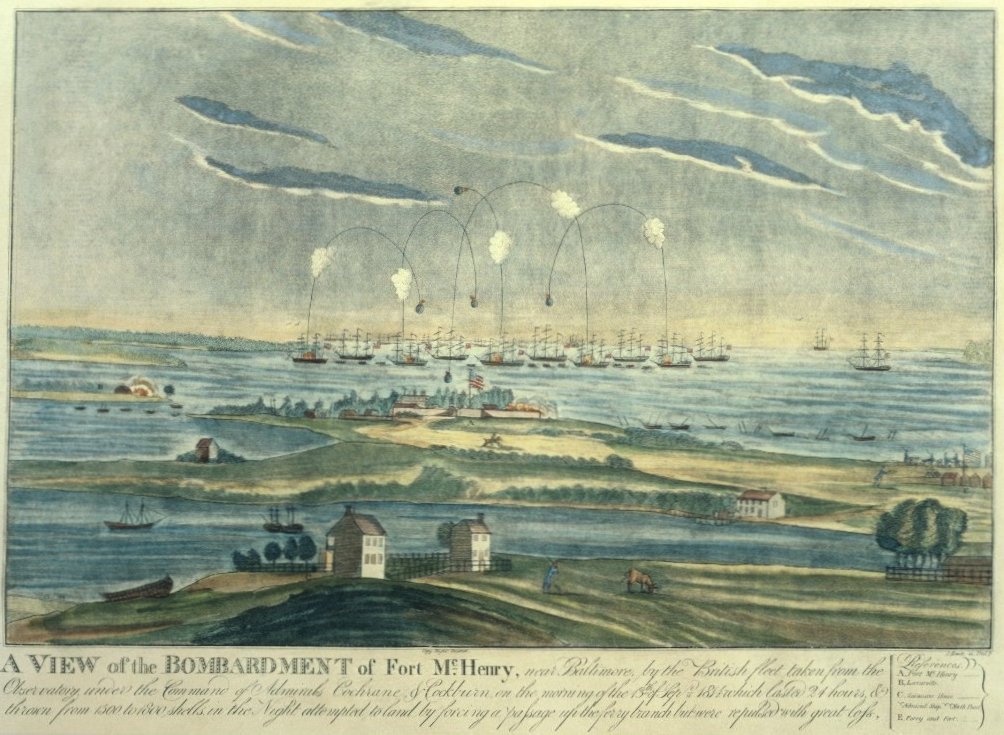 |
| Artist's rendition of the bombardment of Fort McHenry |
As daylight broke through the horizon, it revealed a sight which would flood Francis Scott Key with an overwhelming feeling of joy and ecstasy. It was this awe-inspiring sight that showed that despite how bleak the odds were stacked against them, the Americans had stood their ground, and remained in control of their fort.
It was the sight of their flag, as it waved jubilantly over the fort, basking itself in dawn's early light.
O! say can you see by the dawn's early light, what so proudly we hailed at the twilight's last gleaming, whose broad stripes and bright stars, through the perilous fight, o'er the ramparts we watched, were so gallantly streaming?
And the rockets' red glare, the bombs bursting in air, gave proof through the night that our Flag was still there.
O! say does that star-spangled banner yet wave o'er the land of the free and the home of the brave!