RMS Titanic – Review
On March 1, Minnesotan musician Adam Young released the second album in his conceptual film score project. Last month, I posted about this new project. I was ecstatic, as I saw it as the beginning of Young's return to the grassroots style that he started with—the style I fell in love with. In case you don't know him, Young is perhaps most famous for being the creative mastermind behind Owl City, an electronic music project which has slowly morphed from a dreamy, unique vibe to an almost exclusively pop scene. Young is taking a break from the pop music realm to return to that organic, individualized music production of the good ol' days, releasing a 12-track conceptual "film score" every month for the rest of 2016. Each such score will musically narrate Young's interpretation of a famous historical or fictional event. Each album will be available to stream and download for free on his website. February's score was about the 1969 Apollo 11 spaceflight that was the first to land humans on the moon. March's score is about the 1912 sinking of the RMS Titanic.
 Make no mistake. The sinking of the Titanic was a tragedy. I am struggling to come up with words that would appropriately respect its sheer magnitude. I find that I tend to struggle similarly when trying to describe any tragedy. There's scarcely any honor in tragedy. The word is straightforwardly defined as mass human suffering. It provokes the very heart of human morality. We are not exactly sure how many human beings were tortured and had their lives abruptly ended on that fifteenth day of April, 1912. Estimates place it in the neighborhood of 1500 deaths.
The rest of this post is my narrative of Adam Young's score. I intended it to be read at the same time you listen to the score. Click the play button to start.
Young's score opens with a 2-minute, 7-second track called "Southampton", after the British city whose port was the starting point of the Titanic's maiden voyage. Right away, the rich sound of the cello captures the atmosphere of the port as passengers behold the vast sea and the gigantic ocean liners that will cross it – especially the one ocean liner they are about to board. Compared to such a massive beast of a ship, passengers must feel especially small. The clarity of the instrument is breathtaking. "Boarding" is the logical transition. You can almost hear the passengers bustling about as they excitedly embark on the Titanic.
The next track, "Captain Edward Smith", is my favorite one on this score. Divided into two movements, the first conveys Smith's air of authority as chief officer of the ship. He has 40 years of experience at sea, 27 of those years a commanding officer. As Young put it: crew members stand straighter whenever he's around. As the authoritativeness of the piano subsides – as Smith leaves the navigational bridge – the trombone arrives (or french horn, I'm not exactly sure what it is). It delivers a powerful, deliberate tone, capturing Smith's deep love for the ocean as he stands alone above the bow of the ship, overlooking the vastness of the sea.
As the dignified, heartfelt notes of "Captain Edward Smith" come to a close, we suddenly shift to an exciting, optimistic vibe in "Maiden Voyage" as the RMS Titanic departs from Southampton. The omnipresent rhythm of the strings perfectly encapsulates the feeling of traveling on a ship – breaking through waves, gentle rocking, the distinctive, salty smell of the ocean air. The passionate tone of the flute seals the deal for the track, creating a fun, adventurous atmosphere. "Maiden Voyage" trails just barely behind "Captain Edward Smith" as my second favorite track on the record.
As the cheerful, celebratory energy of the Titanic's departure resonates with us, there is a simultaneous, almost paradoxical inclination to feel melancholy. For we know the story of the Titanic. For we know that the cheery, fun times will not last. For we know that we cannot change history. We want with all our hearts for the happiness of the passengers to be sustained, but we know that it cannot happen.
And so begins "Lookout Duty" – the track, right up to the first second, hits you like freight train. Our first conscious thought is – Oh god, it's happening. We are dreading what's inevitably to come. The piano enters, playing two simple chords – as if it were sealing the fate of 1500 lives right then and there. The tracks grows progressively more ominous as we hear occasional screeches, as if metal was clanking in the dark. And then suddenly, the music stops. What we hear instead are distant noises – we're not sure what they are, but it's as if something within us has just been swept away by some overpowering force. The bass slowly creeps up, until an electric guitar finally plucks two notes. The eeriness is almost palpable. We see ourselves at the top of the mast, looking in the dark, so alone, and so very unaware. The joyful atmosphere of "Maiden Voyage" has long passed – and we know that it will never return.
What begins the next track is silence. The dark, cold silence. It is night. There is no moon. Everyone on the ship is asleep. We hear the distant chime of a bell, so soft and faraway. The pitch-black darkness prevents us from seeing much of anything as we stand at the top of the mast, our eyes peeled. The foreboding silence is almost unbearable.
Suddenly, you see something.
Something big.
The music – without any warning whatsoever – breaks the dead silence with startling, deep notes, as if you're the lookout, and out of the corner of your eye, you see a shadow. An impossibly big shadow – the size of a small mountain. But you're at sea, so how could there be such a thing?
You become alert, your attention undivided as you nervously take stock of the potential threat. And then it dawns on you.
It's an iceberg.
And the ship is headed straight at it.
The music gets increasingly loud and tense as you make futile attempts to sound the alarm. "Iceberg! Right ahead!" you scream, trying to get someone's attention. But it's too late. The tenseness of the track – the menacing, horrifying crescendo – suddenly cuts out as the ship strikes the iceberg. The starboard side of the ship buckles, water overflowing the crucial compartments that give the ship buoyancy. "The Iceberg" ends in the same way it started: with silence. The soft notes of the piano capture your speechlessness as the ship drifts away. You look back, transfixed, at the iceberg as it slowly blends back into the darkness, blurring into obscurity. The deed is done. Now, it's a race against time.
The familiar sound of the traditional orchestra returns with "Distress Call" as passengers, one by one, awaken themselves. In response to the impact, Captain Smith orders the lifeboats uncovered and all of the passengers mustered, or gathered together at specific positions on the ship next to the lifeboats. Smith also commands the Titanic's communicators to send out distress signals. "Distress Call" proceeds melodically, still conveying a sense of majesty for the ship – the passengers still haven't realized the gravity of the circumstance they're in. They take it as a joke when they were told to put on life preservers. The air is freezing, and many passengers want to return to the toasty interior of the ship. As the orchestra steps aside for the soft notes of the piano, there's a sense of false hope – like a mother telling her child: everything's going to be alright. And yet there's the fateful, omnipresent undertone – an insidious nuance of the melody that screams: something terrible has happened.
Something terrible indeed. Owing to the public's impression that ships like the Titanic were unsinkable, lifeboat systems on most ships contemporary to the Titanic were designed only to transport passengers from one ship to another—the possibility that the lifeboats would need to simultaneously hold all passengers was laughable. And given his experience, there was no doubt that Captain Edward Smith knew that. Indeed, in the best case scenario, if every single space on every lifeboat were filled – over a thousand people would still be on the ship, sinking to their inescapable death. The nearest help was hours away. There is no doubt that Smith must have realized the horrifying extent of the situation. As such realization dawned, Smith became overwhelmed. Imagine if you knew someone would die and there was nothing you could do to save them – Smith had the lives of thousands suddenly thrust upon his back. And it broke him. It paralyzed him with indecision. He never even ordered abandon ship. The crew was ill-prepared for an emergency, and Smith failed to organize them properly. Smith didn't even tell some of his top officers that the ship was sinking.
"Sinking" captures the chaos. You're inside the ship, and you see other passengers running up the stairwell, screaming. You feel the ship dangerously swaying to one side. Someone shouts that the bottom decks have already filled with water. Suddenly, it hits home. Joining the panicked crowd, you race up towards the deck. The ship is sinking. You scramble onto the deck and find that there is little order to what's happening. To your left, a half-filled lifeboat is set free by an officer; to your right, an officer is denying all men a seat in favor of "women and children first". While all this is happening, the deck grows steeper and steeper as the bow of the ship submerges itself. Perhaps out of a blind stroke of luck (in an immensely unlucky situation!), you eventually do find yourself on a lifeboat.
The track, "Lifeboats", opens with a piano solo that proceeds slowly, deliberately, as if the survivors are speechless, as they observe the "unsinkable" sink. The piano hands it off to the strings, which play a variation of the Christian hymn "Nearer My God to Thee". It is an ephemeral expression of hope – hope in an endlessly hopeless situation. As if some of those on the lifeboats have found loved ones and are delighted they're okay.
The rejoice is short-lived, as "Every Man for Himself" brings back the horror and the urgency. The strings screech without any coherence. The bow has sunk so deeply that the stern of the ship is completely out of the water. The stress on the middle section of the ship is too much, and as a result, the Titanic splits apart. At this point, those still left on the ship, with no other choice left, leap off the edge into the scathing ice water, where they die within minutes of hypothermia. The "women and children first" protocol had left over a thousand men still on board as last sections of the RMS Titanic say goodbye to the open air forever.
Next comes "Silence". The Titanic that you had so awesomely beheld at the port of Southampton is no more. With it, one thousand five hundred lives are no more. "Silence" opens with this contemplation, a deep respect to the lives that were lost. But this is quickly replaced by a tone of anxiety as the music literally ends. What's left is silence – the same silence as the darkness in "The Iceberg": a piece of metal clangs in the far distance as you and the other survivors wait alone, cold, desperate. Suddenly, something jumps out at you – but you realize it's just the last remnant of the Titanic, the last bit of ship sinking below the surface of the water. You close your eyes. Silence.
"Survivors" is the track where the full scale of this tragedy is appreciated. When it is fully realized that a thousand five hundred lives have just been lost forever. As they are rescued, strangers hug each other in tight, loving embraces, weeping. Children orphaned, families undone, relationships erased. And yet it ends on a somewhat hopeful, somewhat reflective note. The sinking of the Titanic led to sweeping changes to safety regulations at sea, especially those surrounding lifeboats. The public outrage pressured nations to ratify the International Convention for the Safety of Life at Sea in 1914, which is still in effect today. If you've ever been on a cruise, on the first day, there's always that mandatory safety debriefing—during those, I always think of the Titanic. How many lives have been saved as a result of the changes brought about by the sinking of the Titanic? I suppose in many ways, we are all survivors of the RMS Titanic.
 Make no mistake. The sinking of the Titanic was a tragedy. I am struggling to come up with words that would appropriately respect its sheer magnitude. I find that I tend to struggle similarly when trying to describe any tragedy. There's scarcely any honor in tragedy. The word is straightforwardly defined as mass human suffering. It provokes the very heart of human morality. We are not exactly sure how many human beings were tortured and had their lives abruptly ended on that fifteenth day of April, 1912. Estimates place it in the neighborhood of 1500 deaths.
The rest of this post is my narrative of Adam Young's score. I intended it to be read at the same time you listen to the score. Click the play button to start.
Young's score opens with a 2-minute, 7-second track called "Southampton", after the British city whose port was the starting point of the Titanic's maiden voyage. Right away, the rich sound of the cello captures the atmosphere of the port as passengers behold the vast sea and the gigantic ocean liners that will cross it – especially the one ocean liner they are about to board. Compared to such a massive beast of a ship, passengers must feel especially small. The clarity of the instrument is breathtaking. "Boarding" is the logical transition. You can almost hear the passengers bustling about as they excitedly embark on the Titanic.
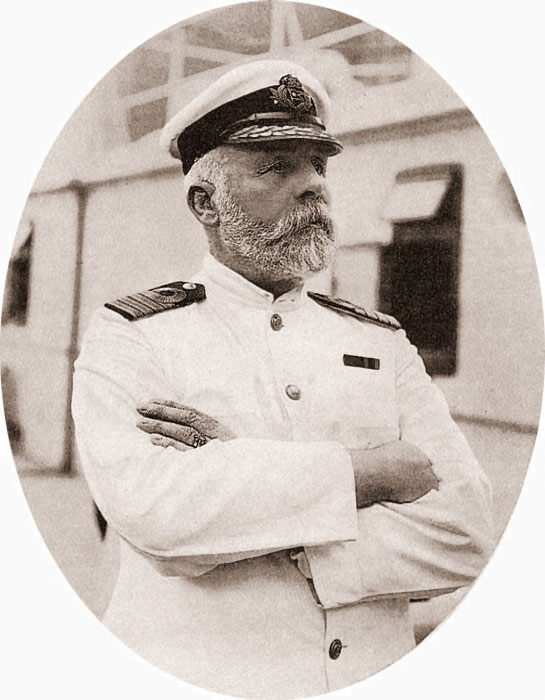 |
| Edward Smith (1850 – 1912) Captain of the RMS Titanic |
As the dignified, heartfelt notes of "Captain Edward Smith" come to a close, we suddenly shift to an exciting, optimistic vibe in "Maiden Voyage" as the RMS Titanic departs from Southampton. The omnipresent rhythm of the strings perfectly encapsulates the feeling of traveling on a ship – breaking through waves, gentle rocking, the distinctive, salty smell of the ocean air. The passionate tone of the flute seals the deal for the track, creating a fun, adventurous atmosphere. "Maiden Voyage" trails just barely behind "Captain Edward Smith" as my second favorite track on the record.
As the cheerful, celebratory energy of the Titanic's departure resonates with us, there is a simultaneous, almost paradoxical inclination to feel melancholy. For we know the story of the Titanic. For we know that the cheery, fun times will not last. For we know that we cannot change history. We want with all our hearts for the happiness of the passengers to be sustained, but we know that it cannot happen.
And so begins "Lookout Duty" – the track, right up to the first second, hits you like freight train. Our first conscious thought is – Oh god, it's happening. We are dreading what's inevitably to come. The piano enters, playing two simple chords – as if it were sealing the fate of 1500 lives right then and there. The tracks grows progressively more ominous as we hear occasional screeches, as if metal was clanking in the dark. And then suddenly, the music stops. What we hear instead are distant noises – we're not sure what they are, but it's as if something within us has just been swept away by some overpowering force. The bass slowly creeps up, until an electric guitar finally plucks two notes. The eeriness is almost palpable. We see ourselves at the top of the mast, looking in the dark, so alone, and so very unaware. The joyful atmosphere of "Maiden Voyage" has long passed – and we know that it will never return.
What begins the next track is silence. The dark, cold silence. It is night. There is no moon. Everyone on the ship is asleep. We hear the distant chime of a bell, so soft and faraway. The pitch-black darkness prevents us from seeing much of anything as we stand at the top of the mast, our eyes peeled. The foreboding silence is almost unbearable.
Suddenly, you see something.
Something big.
The music – without any warning whatsoever – breaks the dead silence with startling, deep notes, as if you're the lookout, and out of the corner of your eye, you see a shadow. An impossibly big shadow – the size of a small mountain. But you're at sea, so how could there be such a thing?
You become alert, your attention undivided as you nervously take stock of the potential threat. And then it dawns on you.
It's an iceberg.
And the ship is headed straight at it.
The music gets increasingly loud and tense as you make futile attempts to sound the alarm. "Iceberg! Right ahead!" you scream, trying to get someone's attention. But it's too late. The tenseness of the track – the menacing, horrifying crescendo – suddenly cuts out as the ship strikes the iceberg. The starboard side of the ship buckles, water overflowing the crucial compartments that give the ship buoyancy. "The Iceberg" ends in the same way it started: with silence. The soft notes of the piano capture your speechlessness as the ship drifts away. You look back, transfixed, at the iceberg as it slowly blends back into the darkness, blurring into obscurity. The deed is done. Now, it's a race against time.
The familiar sound of the traditional orchestra returns with "Distress Call" as passengers, one by one, awaken themselves. In response to the impact, Captain Smith orders the lifeboats uncovered and all of the passengers mustered, or gathered together at specific positions on the ship next to the lifeboats. Smith also commands the Titanic's communicators to send out distress signals. "Distress Call" proceeds melodically, still conveying a sense of majesty for the ship – the passengers still haven't realized the gravity of the circumstance they're in. They take it as a joke when they were told to put on life preservers. The air is freezing, and many passengers want to return to the toasty interior of the ship. As the orchestra steps aside for the soft notes of the piano, there's a sense of false hope – like a mother telling her child: everything's going to be alright. And yet there's the fateful, omnipresent undertone – an insidious nuance of the melody that screams: something terrible has happened.
Something terrible indeed. Owing to the public's impression that ships like the Titanic were unsinkable, lifeboat systems on most ships contemporary to the Titanic were designed only to transport passengers from one ship to another—the possibility that the lifeboats would need to simultaneously hold all passengers was laughable. And given his experience, there was no doubt that Captain Edward Smith knew that. Indeed, in the best case scenario, if every single space on every lifeboat were filled – over a thousand people would still be on the ship, sinking to their inescapable death. The nearest help was hours away. There is no doubt that Smith must have realized the horrifying extent of the situation. As such realization dawned, Smith became overwhelmed. Imagine if you knew someone would die and there was nothing you could do to save them – Smith had the lives of thousands suddenly thrust upon his back. And it broke him. It paralyzed him with indecision. He never even ordered abandon ship. The crew was ill-prepared for an emergency, and Smith failed to organize them properly. Smith didn't even tell some of his top officers that the ship was sinking.
"Sinking" captures the chaos. You're inside the ship, and you see other passengers running up the stairwell, screaming. You feel the ship dangerously swaying to one side. Someone shouts that the bottom decks have already filled with water. Suddenly, it hits home. Joining the panicked crowd, you race up towards the deck. The ship is sinking. You scramble onto the deck and find that there is little order to what's happening. To your left, a half-filled lifeboat is set free by an officer; to your right, an officer is denying all men a seat in favor of "women and children first". While all this is happening, the deck grows steeper and steeper as the bow of the ship submerges itself. Perhaps out of a blind stroke of luck (in an immensely unlucky situation!), you eventually do find yourself on a lifeboat.
 |
| Untergang der Titanic by Willy Stöwer, 1912 |
The rejoice is short-lived, as "Every Man for Himself" brings back the horror and the urgency. The strings screech without any coherence. The bow has sunk so deeply that the stern of the ship is completely out of the water. The stress on the middle section of the ship is too much, and as a result, the Titanic splits apart. At this point, those still left on the ship, with no other choice left, leap off the edge into the scathing ice water, where they die within minutes of hypothermia. The "women and children first" protocol had left over a thousand men still on board as last sections of the RMS Titanic say goodbye to the open air forever.
Next comes "Silence". The Titanic that you had so awesomely beheld at the port of Southampton is no more. With it, one thousand five hundred lives are no more. "Silence" opens with this contemplation, a deep respect to the lives that were lost. But this is quickly replaced by a tone of anxiety as the music literally ends. What's left is silence – the same silence as the darkness in "The Iceberg": a piece of metal clangs in the far distance as you and the other survivors wait alone, cold, desperate. Suddenly, something jumps out at you – but you realize it's just the last remnant of the Titanic, the last bit of ship sinking below the surface of the water. You close your eyes. Silence.
"Survivors" is the track where the full scale of this tragedy is appreciated. When it is fully realized that a thousand five hundred lives have just been lost forever. As they are rescued, strangers hug each other in tight, loving embraces, weeping. Children orphaned, families undone, relationships erased. And yet it ends on a somewhat hopeful, somewhat reflective note. The sinking of the Titanic led to sweeping changes to safety regulations at sea, especially those surrounding lifeboats. The public outrage pressured nations to ratify the International Convention for the Safety of Life at Sea in 1914, which is still in effect today. If you've ever been on a cruise, on the first day, there's always that mandatory safety debriefing—during those, I always think of the Titanic. How many lives have been saved as a result of the changes brought about by the sinking of the Titanic? I suppose in many ways, we are all survivors of the RMS Titanic.